There is a particular kind of exhaustion that many people with ADHD know well. It is not the tiredness that comes from doing too much. It is the tiredness that comes from the gap between what you intended to do and what actually happened – from a day that somehow slipped away, a task that felt impossible to start, a moment when everything at once became too much and you simply froze.
Overwhelm is one of the most frequently described experiences in people with ADHD, and one of the least well understood by people on the outside. It looks, from a distance, like laziness or avoidance. It does not feel that way at all.
Understanding why overwhelm happens – what is actually going on in the ADHD brain – is not just academically interesting. It changes how you talk to yourself about it. And that matters.
ADHD is not just about attention
The name “attention deficit hyperactivity disorder” is in many ways misleading. It suggests the core issue is simply paying attention, perhaps with some restlessness on top. But the research picture is considerably more complex than that.
ADHD is now understood to be primarily a condition affecting executive function – the set of cognitive skills that allow us to plan, prioritise, regulate our emotions, manage time, initiate tasks and shift flexibly between demands. The prefrontal cortex, which is responsible for much of this work, develops and functions differently in ADHD brains.
This is why overwhelm in ADHD is not about the volume of what needs doing. It is about the brain’s difficulty processing, ordering and beginning. A single task can feel overwhelming. So can ten tasks. The problem is not always the size of the pile – it is the difficulty the brain has in knowing where to start, or in convincing itself to start at all.
The role of dopamine
To understand overwhelm in ADHD, it helps to know a little about dopamine. Dopamine is a neurotransmitter involved in motivation, reward and the regulation of attention. In ADHD brains, dopamine pathways function differently – not necessarily producing less dopamine, but regulating and responding to it in ways that affect how the brain motivates itself.
In practical terms, this means that the ADHD brain often struggles to generate motivation for tasks that do not carry an immediate and meaningful reward. Neurotypical brains can to some extent override this – they can motivate themselves through abstract future consequences (“if I do this now, things will go better later”). ADHD brains find this much harder.
What this produces is a motivation system that is heavily interest-based. Tasks that are novel, urgent, challenging or personally meaningful can generate enough dopamine to engage the brain fully. Tasks that are routine, low-stimulus or low-interest can feel genuinely impossible to begin, regardless of how important they objectively are.
This is not a character flaw. It is neurology.
Task initiation and why “just starting” is harder than it sounds
One of the most common experiences people describe is knowing exactly what they need to do, wanting to do it and being completely unable to begin. This is sometimes called task paralysis, and it sits at the heart of ADHD overwhelm.
From the outside, it looks like procrastination. The person is sitting there, the task is in front of them, nothing appears to be in the way. But internally, the brain is struggling to generate the initiating signal. It knows the task exists but cannot bridge the gap between knowing and doing.
This gap is made wider by anything that increases cognitive load. When there are multiple things to do, with unclear priority order, the brain has to decide what to do before it can do anything – and that decision-making process can become its own source of overwhelm. The result is sometimes total shutdown: the person does nothing, not out of choice, but because the system has become too overloaded to produce any output at all.

Emotional overwhelm in ADHD
Overwhelm in ADHD is not only cognitive. There is a strong emotional dimension that is often overlooked in descriptions of the condition.
Emotional dysregulation – difficulty managing the intensity and duration of emotional responses – is increasingly recognised as a core feature of ADHD rather than a secondary symptom. People with ADHD often experience emotions more intensely than neurotypical people, and those emotions arrive faster and can be harder to shift.
This means that a difficult email, a minor criticism, an unexpected change of plan or a conversation that goes slightly wrong can trigger an emotional response that feels disproportionate but is entirely real. That response then adds to the cognitive load already in the system, making it even harder to think clearly, prioritise or act.
Many people describe a kind of emotional snowball effect. One thing goes wrong. The feeling is intense. Managing the feeling takes up mental resource. Other things begin to slip. The slipping produces more feeling. At some point, the whole system becomes too overloaded to function, and the only available response is to stop.
Sensory overwhelm
For many people with ADHD – and particularly those who are also autistic – sensory input plays a significant role in overwhelm. The ADHD brain can struggle to filter irrelevant sensory information in the same way a neurotypical brain might, meaning that noise, light, physical discomfort or a busy environment can contribute significantly to overload.
This is one reason why open-plan offices, busy supermarkets or loud family gatherings can tip someone with ADHD over the edge when they might otherwise be managing fine. The cognitive and emotional demands of the environment are simply higher than they appear from the outside, and they stack on top of everything else the brain is already working to manage.
Time blindness and the overwhelm cycle
People with ADHD often describe a complicated relationship with time. Sometimes called time blindness, this refers to the difficulty many ADHD brains have in perceiving time accurately and planning around it. There is a common experience of there being only two times: now and not now.
This creates its own contribution to overwhelm. Deadlines that feel abstract and far away do not generate the sense of urgency needed to begin. Then, suddenly, they are immediate and everything happens at once. The resulting rush, or the guilt and shame of having left things too late again, feeds the emotional overwhelm described above and reinforces the cycle.

What helps
Understanding why overwhelm happens is genuinely useful, but it is also worth knowing that there are practical strategies that make a real difference for people with ADHD. These are not about trying harder or being more disciplined – they are about working with the brain rather than against it.
Some of the approaches that tend to help include:
Body doubling
Working alongside another person, even in silence, which can help the brain generate enough stimulation to initiate and sustain tasks.
External structure
Using physical tools like timers, visible to-do lists and calendar alerts to reduce the amount of internal organisation the brain has to manage.
Task chunking
Breaking tasks into very small steps with clear starting points, so the brain only has to commit to one small action rather than a whole project.
Sensory management
Identifying and adjusting the environment to reduce unhelpful sensory input, whether that means noise-cancelling headphones, a quieter workspace or more regular breaks.
Self-compassion
Which sounds simple but is one of the hardest and most important pieces. The shame and self-criticism that often surround ADHD overwhelm make it significantly worse. Understanding that the difficulty is neurological, not moral, creates the mental space needed to problem-solve rather than simply catastrophise.
Post-diagnostic coaching and therapy can be particularly valuable here, helping people identify which strategies work for them individually and build sustainable systems around their actual brain rather than an idealised version of it.
You are not failing. Your brain is working differently.
Overwhelm with ADHD is not a sign of weakness, lack of effort or poor character. It is a predictable outcome of how the ADHD brain processes the demands of modern life – a life that was largely designed around neurotypical ways of organising, prioritising and sustaining effort.
That does not mean nothing can change. With the right understanding, the right support and strategies that are built around your specific brain, everyday life can become considerably more manageable. Not perfect, not effortless – but genuinely better.
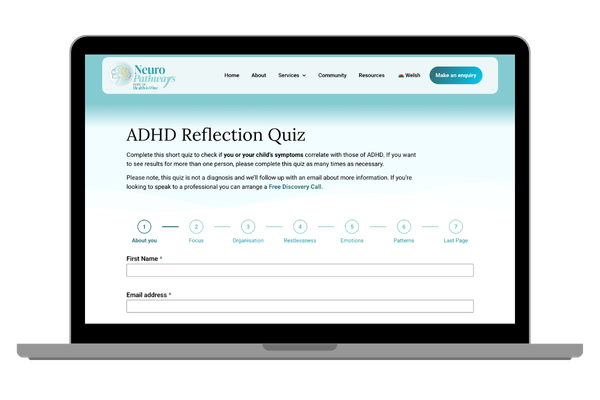
If you recognise the patterns described here and have never explored whether ADHD might be a factor, it may be worth taking that step. A good assessment will not just tell you whether you have ADHD. It will start to make sense of experiences that may have felt confusing or shameful for a very long time.
At Neuropathways, we offer thorough, supportive assessments alongside post-diagnostic coaching and therapy. If you would like to talk things through, we are here.