When you are choosing someone to support you, your child or a member of your family, it can be difficult to know what to look for.
A website might tell you that a clinician is qualified, that a service follows national guidance or displays a collection of accreditation logos. But unless you already work in healthcare, knowing what those things actually mean is not always straightforward.
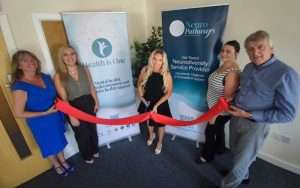
Health Is One and Neuropathways Clinic is registered with Healthcare Inspectorate Wales (HIW).
This gives the people using our services another layer of independent reassurance about the way their care is provided.
It also gives us an opportunity to explain some of the different standards, registrations and accreditations behind our work, and why they are worth looking for when you are choosing a healthcare professional or service.
Healthcare Inspectorate Wales: looking at the service as a whole
Healthcare Inspectorate Wales regulates independent healthcare services in Wales that fall within the scope of registration.
For a provider to be registered, HIW must be satisfied that it will comply with the relevant regulations and national minimum standards. Registration also brings responsibilities that continue once a service is operating.
That distinction is important.
When choosing support, it is not only the qualifications of the individual clinician that matter. The systems around them matter too. How a service is run, how people are safeguarded, how concerns are handled and how standards are maintained all form part of the experience of receiving care. Our HIW registration provides independent oversight of that wider picture.
HCPC registration: checking the professional supporting you
There is another question worth asking when choosing a specialist: Are they registered with the appropriate professional regulator?
Every Clinical and Medical professional working with us is registered with the Health and Care Professions Council (HCPC) or the General Medical council (GMC).
This gives you a practical way to check who you are working with. Rather than relying solely on a biography or list of qualifications on a website, you can verify a professional’s registration independently.
It might seem like a small thing, but when you are placing your trust in someone’s clinical judgement, that transparency matters.
NICE guidance: Making sure care is evidence informed
Qualifications tell you about the professional. Registration tells you about accountability. But it is also reasonable to ask what informs the care itself.
Our clinical work follows relevant guidance from the National Institute for Health and Care Excellence (NICE).
NICE develops its recommendations using the best available evidence, drawing on research alongside the experience of professionals and people who use services.
Following NICE guidance helps ensure that assessment and support are grounded in established clinical evidence and recognised good practice.
That does not mean treating everyone in exactly the same way. Good care still needs to take account of the individual in front of you. Evidence provides the foundation, while clinical expertise and the person’s own needs, experiences and preferences shape what happens next.
BACP accreditation: Standards for therapeutic support
We use the BACP Ethical Framework for counselling and psychotherapy to guide our practice and uphold professional standards.
The British Association for Counselling and Psychotherapy (BACP) describes its Ethical Framework as a foundation for accountable, ethical, and responsive practice. Services that align with this framework commit to maintaining clear boundaries, confidentiality, and professional integrity.
The systems you might never see
Some of the standards we hold are less directly visible during an appointment, but they are still an important part of providing responsible healthcare.
Our ISO 9001:2015 certification relates to quality management. It means there are structured processes behind the way we work, including how we monitor quality and continue to improve our services.
ISO/IEC 27001 relates specifically to information security management. It provides a framework for identifying and managing risks around the information an organisation holds.
That matters particularly in healthcare. The information you share with us can be highly personal, so protecting it needs to be part of the way a service is designed, rather than something considered afterwards.
We also hold Cyber Essentials Plus. Unlike the standard Cyber Essentials assessment, the Plus certification includes independent technical testing to check that key cyber security controls are working in practice.
You may never notice those systems during an assessment or therapy session. Ideally, you should not need to. But they are working behind the scenes to support the safe and responsible handling of your information.
Disability Confident Employer: bringing our values into our own workplace
We are also a Disability Confident Employer.
The government-backed Disability Confident scheme encourages employers to remove barriers, improve recruitment and support disabled people and people with long-term health conditions to develop and thrive at work.
At the employer level, organisations complete a self-assessment covering how they recruit, retain and develop disabled people.
For us, inclusion should not only be something we talk about with the people who use our services. It should be reflected in the kind of organisation we are building too.
What should you look for when choosing a provider?
Accreditations alone cannot tell you whether a particular clinician or service will be the right fit for you. But they can help you ask better questions.
- Is the professional registered with the regulator you would expect for their role?
- Is the service itself appropriately regulated?
- Does its clinical approach follow recognised evidence and guidance?
- Are there clear standards around confidentiality, safeguarding and data protection?
- And if something does go wrong, is there meaningful professional or regulatory accountability?
These are reasonable questions to ask any provider.
The important thing is not how many logos appear on a website. It is what sits behind them.
For us, our registrations, accreditations and certifications form different parts of the same commitment: providing thoughtful, evidence-informed support within services that are professionally run, accountable and always looking for ways to improve.
If you would like to understand more about Neuropathways Clinic, our assessment pathways or the support available across Health Is One, you can speak to our team or book a free discovery call.